Es gibt keine Website-Inhalte zu Ihrer Suchanfrage.
Website-Inhalte
Sie haben sich erfolgreich abgemeldet.


Prävention postoperativer Wundinfektionen
Prävention von postoperativen Wundinfektionen (SSI)
Das Ziel aller Hygienemaßnahmen ist die Reduktion von postoperativen Wundinfektionen und anderen nosokomialen Infektionen sowie der Schutz der Mitarbeitenden vor berufsbedingten Infektionen. Um die Infektionsrate so gering wie möglich zu halten, sollte man den gesamten Prozess betrachten und optimieren sowie Bundle-Strategien entwickeln.
Fokusthema
Postoperative Wundinfektionen in der Veterinärmedizin (SSI – Surgical Site Infections)
Mehr erfahrenZur gezielten Prävention postoperativer Wundinfektionen sollten folgende Prozesse betrachtet werden.
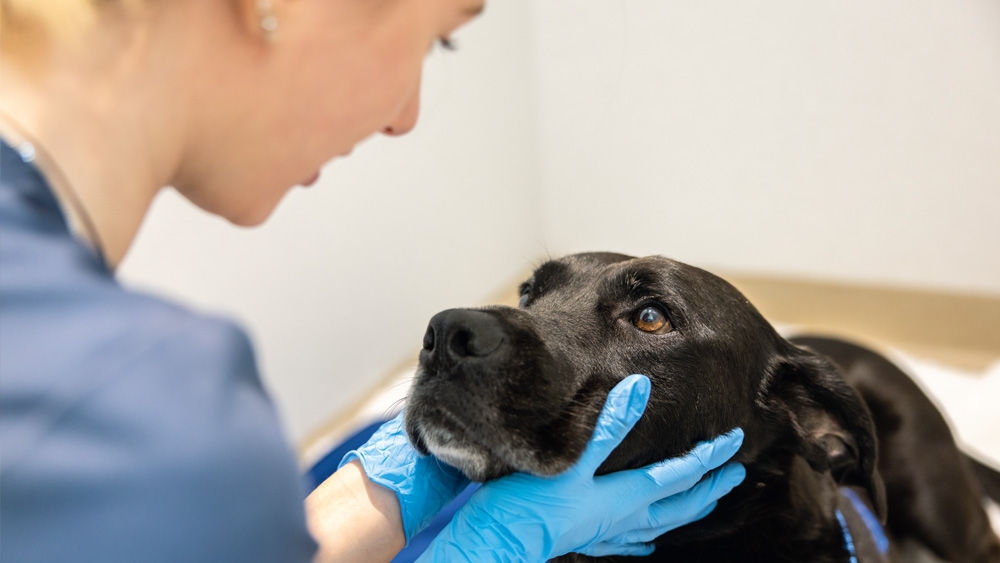
Präoperative Untersuchung des Patienten/Dekolonisation: Der Gesundheitsstatus des Patienten ist ein wichtiger Risikofaktor für das SSI Risiko (postoperative Wundinfektionen).1, 2 Daher sollten die Patienten vor einer Operation gründlich untersucht werden und ggf. Erkrankungen und oder lokale Hautinfektionen möglichst vor der Operation diagnostiziert und behandelt werden.
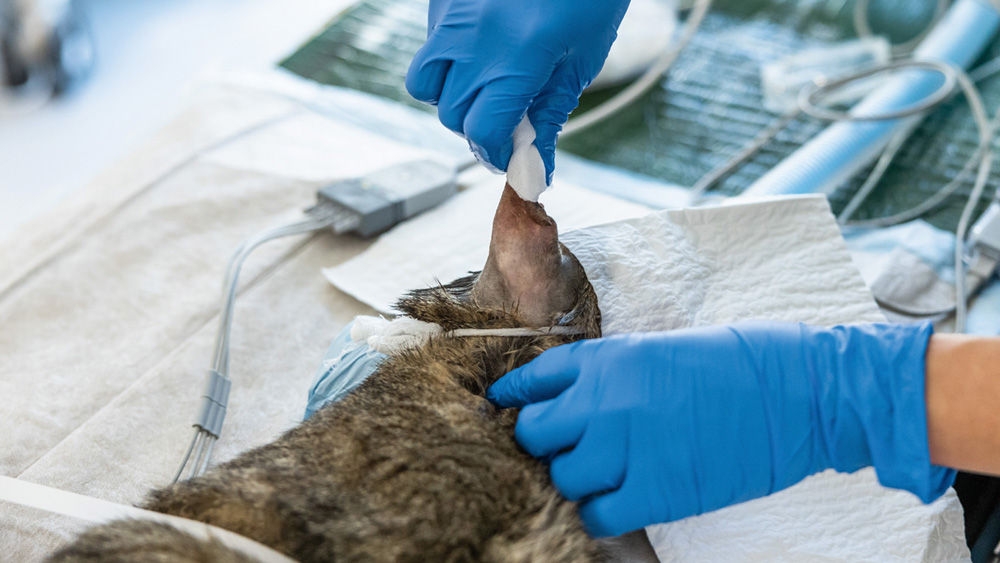
Optimierung der Anästhesiezeit: Die Gesamtdauer der Anästhesie hat, ebenso wie die Gesamtdauer der Operation, einen Einfluss auf die SSI-Rate2-4 und sollte daher so kurz wie möglich gehalten werden. Dies kann durch eine gute Planung des OP-Tages und eine Optimierung der allgemeinen Abläufe erreicht werden.
Normothermie: Die perioperative Hypothermie ist in der Humanmedizin mit einer erhöhten SSI-Rate verbunden. In der Tiermedizin gibt es dazu weniger eindeutige Evidenz, allerdings ist eine Hypothermie mit einer Verlängerung der Aufwachphase und damit der Anästhesiezeit verbunden5, 6 und diese hat einen signifikanten Effekt auf die SSI-Rate.2-4, 7 Außerdem geht die perioperative Hypothermie mit einer erhöhten Mortalitätsrate bei Notfallprozeduren einher.8 Daher sollte die Temperatur des Patienten Teil des regulären Monitorings sein, um ggf. therapeutische Maßnahmen ergreifen zu können.
Hypotension: Tiere, die während der Operation hypotensiv werden, haben eine 27-fach höhere Wahrscheinlichkeit, eine postoperative Wundinfektion zu entwickeln. Daher sollte der Blutdruck während der gesamten Zeit der Anästhesie überwacht und ggf. therapiert werden.9
Oxygenierung: Hypoxie wurde in zahlreichen Studien in der Humanmedizin als Risikofaktor für SSI beschrieben.10-12 Daher sollte während der gesamten OP und der Anästhesiezeit die Oxygenierung gemonitort und ggf. korrigiert werden.
Glucose: Perioperative Hyperglykämie ist mit einer erhöhten SSI-Rate assoziiert.13-15 Daher sollte, vor allem bei Patienten mit Diabetes mellitus, vor und während der gesamten Operation, die Glucose überwacht und wenn nötig behandelt werden.16, 17
Präoperative Haarentfernung: Das OP-Areal muss ausreichend großflächig geschoren werden (mindestens eine Handbreit um den erwarteten Schnitt). Die Schur der Haare sollte dabei außerhalb des OPs erfolgen und so hautschonend wie möglich durchgeführt werden (keine Nassrasur). Optimalerweise werden alle diagnostischen Maßnahmen, wie z. B. Röntgen, vor der Schur durchgeführt. Eine Schur unmittelbar vor dem Eingriff ist empfehlenswert. Maximal sollten 4 Stunden zwischen Schur und OP liegen.18, 19
Präoperatives Waschen: In der Humanmedizin wird empfohlen, dass sich die Patienten am Abend oder frühmorgens vor der OP gründlich waschen,13, 20, 21 um eine deutliche Reduktion der Hautflora zu erreichen. Da dies für die tierischen Patienten schwer umzusetzen ist, sollte eine gründliche Reinigung des OP-Bereiches nach der Schur durchgeführt werden. Ziel ist die Reduktion der transienten Hautflora, sowie die Entfernung von Talg, Fett und Schmutz. Dabei sollte auf Wasser und Seife verzichtet werden, da diese die Wirkung des Antiseptikums (z. B. Alkohol) reduzieren können.22 Die Reinigung der Haut kann mit einem Trockenschaum (Prontoderm® Foam) oder Reinigungslotion (Prontoderm® Solution) erfolgen. Das Produkt wird mit einer keimarmen Kompresse oder Tuch auf die geschorene Haut aufgetragen und die Haut gereinigt. Nach 1-2 Minuten die Überreste mit einem sauberen Tuch oder Tupfer abtrocknen.
Bei einer Waschung des Patienten zuhause durch den Besitzer, sollte das Fell des Patienten mit einem in Prontoderm® Solution getränkten Waschlappen oder mit Prontoderm® Foam gründlich eingerieben und gereinigt werden. Nach 3-5 Minuten das Fell mit einem sauberen Handtuch trockenreiben.
Antiseptik des OP-Feldes: Die Antiseptik nimmt eine Schlüsselfunktion in der Prävention der SSI ein, da durch die Durchtrennung der Haut eine Verschleppung der residenten Flora in die Tiefe des OP-Feldes möglich ist. Alkohol ist auf Grund seiner schnellen und guten Wirksamkeit das Mittel der ersten Wahl.13, 20, 21 Kontrovers ist die Diskussion um den remanenten Wirkstoff. Traditionell ist in einigen Ländern PVP-Iod oder Chlorhexidin das Mittel der Wahl. Es gibt kontroverse Studien aus der Humanmedizin, die jeweils dem einen oder dem anderen Wirkstoff den Vorzug geben. In Metaanalysen der verschiedenen Studien hatte keines der beiden Antiseptika einen Vorzug gegenüber dem anderen. 21, 23 Allerdings ist die Wirkung von Chlorhexidin bei multiresistentem Staphylocococcus aureus im Vergleich zu PVP-Iod reduziert. [24] Andere Autoren berichten von einer Chlorhexidin-Resistenz bei Escherichia coli, Salmonella spp., Staphylococcus aureus oder koagulasenegativen Staphylokokken, Enterobacter spp., Pseudomonas spp., Proteus spp., Providencia spp. und Enterococcus spp.25
Wir empfehlen daher die Anwendung eines Alkohol-PVP-Iod Präparates.
Die Haut des Patienten wird für 30 Sekunden mit einem sterilen in Braunoderm® getränkten Tupfer und unter Hilfenahme einer sterilen Kornzange mit Braunoderm® eingerieben. Dabei immer von dem erwarteten Schnittfeld sich nach außen vorarbeiten. Anschließend die Einwirkzeit des Herstellers beachten und dann den Vorgang noch 2-mal wiederholen. Für die Schleimhautantisepsis kommt PVP-Iod (Braunol®) oder Polyhexanid (Prontovet® Solution) in Betracht.20
Inzisionsfolie: Für die Verwendung von Inzisionsfolie in der Tiermedizin fehlen entsprechende Studien. In der Humanmedizin wird von nicht antiseptisch imprägnierten Inzisionsfolien abgeraten, da sie das SSI Risiko steigern können.26
Zudem finden Sie im AESCULAP® Chirurgische Instrumente Online-Katalog die passenden Kornzangen sowie Nierenschalen.
Bereichskleidung: Soll eine Verschleppung von Bakterien in beide Richtungen verhindern. Auch wenn der infektionspräventive Effekt in keiner Vergleichsstudie dargelegt wurde, erscheint dieses Vorgehen als vorteilhaft, da die normale Berufskleidung mit fakultativ pathogenen Erregern, einschließlich MRE (Multiresistenten Erregern) kontaminiert sein kann.27, 28
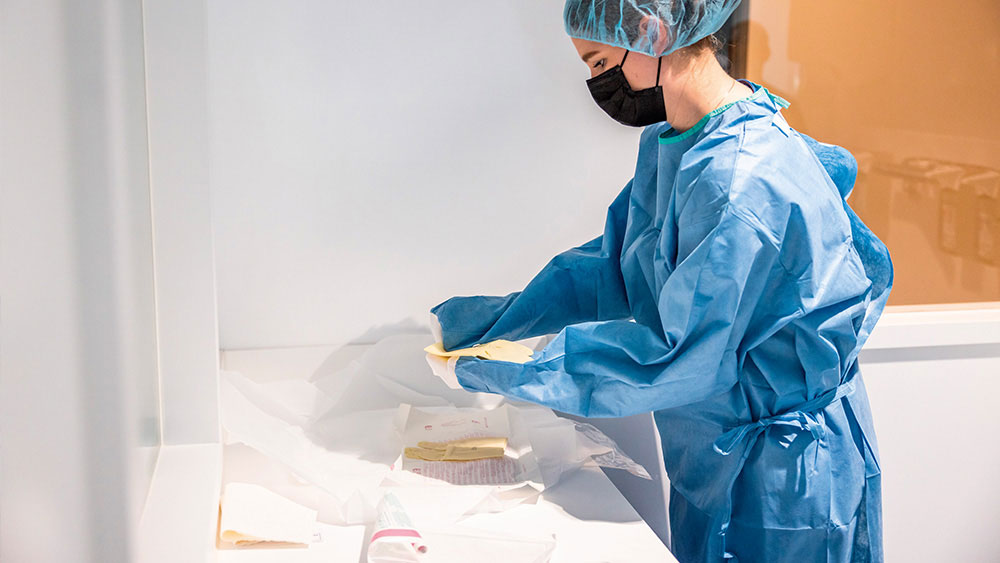
Bereichskleidung: Soll eine Verschleppung von Bakterien in beide Richtungen verhindern. Auch wenn der infektionspräventive Effekt in keiner Vergleichsstudie dargelegt wurde, erscheint dieses Vorgehen als vorteilhaft, da die normale Berufskleidung mit fakultativ pathogenen Erregern, einschließlich MRE (Multiresistenten Erregern) kontaminiert sein kann.27, 28
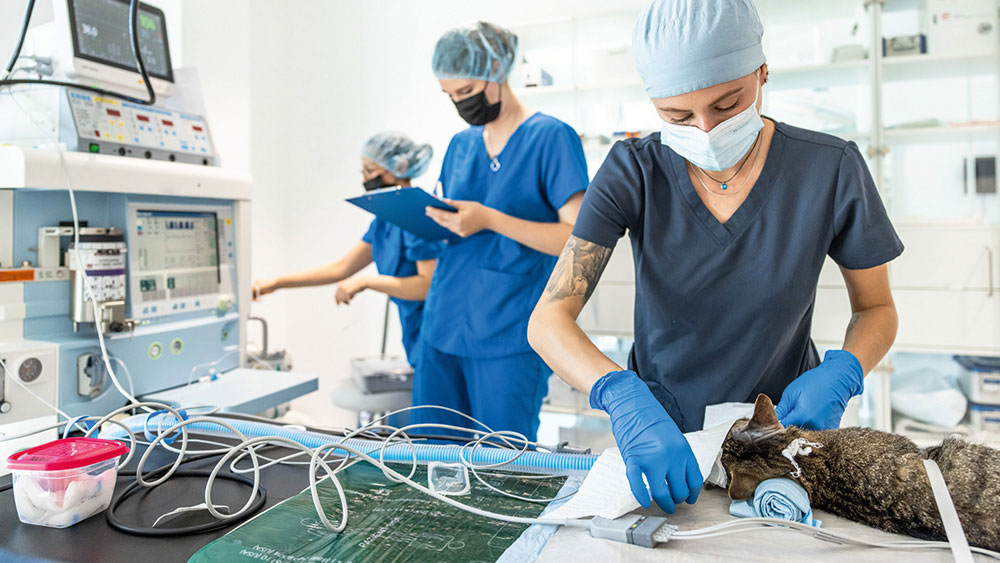
Haarschutz und OP-Maske: Das Tragen von Haarschutz und OP-Maske sind plausibel. Die mikrobielle Belastung der Raumluft ist nachgewiesen, daher sollten beide Schutzmaßnahmen im OP-Saal und während der OP getragen werden.29, 30
OP-Schuhe und Schuh-Überzieher: Von außen eingeführte Bakterien vom Boden können den Bakteriengehalt in der Luft erhöhen und damit bis zu 15 % zur Luftkontamination beitragen.31, 32 Daher empfiehlt sich das Tragen von OP-Schuhen oder Überziehern.
Sterile Schutzkleidung: Die sterile Schutzkleidung stellt eine Barrierefunktion dar, die vor allem zum Schutz des OP-Personals wichtig ist. Einmal-OP-Kittel sind dabei deutlich weniger durchlässig für Bakterien als waschbare Baumwoll-Kittel und daher zu bevorzugen.33, 34 Auch sind Einmal-OP-Kittel aus ökonomischer Sicht besser und können die SSI-Rate senken.34-36
Schutzbrille: Eine Schutzbrille sollte bei allen Prozeduren, bei denen die Gefahr besteht, dass Körperflüssigkeiten oder potentiell infektiöses Material (z. B. septische Chirurgie, Zahnmedizin, Arbeiten mit oszillierenden oder rotierenden Geräten, Granulomen) verspritzt wird, getragen werden.
Händewaschung: Die Handwaschung ist der erste Schritt bei der Vorbereitung für den OP-Tag und sollte vor dem Anlegen der OP-Bereichskleidung durchgeführt werden. Wenn möglich sollte ein Abstand von mindestens 10 Minuten zwischen Händewaschung und alkoholischer Handdesinfektion liegen, da dadurch eine Verminderung der Wirksamkeit des Alkohols ausgeschlossen wird. 22Auch sollte die Händewaschung nicht routinemäßig vor jeder OP durchgeführt werden, da durch das Waschen die Haut wiederholt entfettet wird und es dadurch zu Austrocknung und Schädigung der Haut kommt. 20Sollte das Personal zwischen den Operationen den OP-Trakt verlassen und anderen Tätigkeiten nachgehen, sollte eine erneute Händewaschung vor dem Betreten des OP-Bereiches durchgeführt werden. Generell sollte die Händewaschung mit einer parfumfreien, pH-neutralen Seife, wie z. B. Softaskin® pure durchgeführt werden. Dabei sind 15-Sekunden Händewaschung ausreichend, um Sporen, Schmutz und Organismen deutlich zu reduzieren.
Chirurgische Händedesinfektion: Die chirurgische Händedesinfektion ist von dem gesamten Personal, welches an der OP beteiligt ist, und zudem vor jeder OP durchzuführen. Das Mittel der Wahl sind alkoholbasierte Präparate, wie z. B. Promanum® pure. Die Einreibung sollte mindestens zwei Minuten betragen (unabhängig von den Herstellerangaben, wenn unter 90 Sekunden).37-41
OP-Handschuhe: OP-Handschuhe gibt es in unterschiedlicher Qualität und in verschiedenen Materialien. Die Perforation der Handschuhe ist ein großes Problem während der OP. Dabei haben sich Latex-Handschuhe weniger perforationsanfällig gezeigt z. B. Vasco® OP-Grip / Vasco® OP-Sensitive.42, 43 Die Handschuhe sollten erst nach vollständiger Trocknung der Hände nach der Händedesinfektion angezogen werden, da anderenfalls das Risiko von Perforationen steigt und mehr Hautirritationen begünstigt werden. Die Häufigkeit der Perforation des Handschuhs bei einer OP liegt zwischen 12,7 % und 31 %. Bei der Nutzung von zwei Handschuhen übereinander (Double-Gloving) liegt das Risiko der Perforation des inneren Handschuhs bei 3,8 % bis 13 %.44-46
Generell sollte der OP-Handschuhe alle 60 Minuten gewechselt werden. Auch sollte ein Wechsel der Handschuhe vor dem Einsetzen eines Implantats45 und selbstverständlich auch nach Abschluss des „unsauberen Teils“ einer OP (z. B. nach Darmresektion) erfolgen.
Es gibt drei unterschiedliche Methoden Handschuhe anzuziehen. Man unterscheidet in ‘geschlossen’, ‘offen’ oder ‘assistiert’. Dabei sollte die offene Methode nicht für chirurgische Eingriffe angewandt werden. Die sicherste Methode ist die assistierte, denn auch bei der geschlossenen Methode konnte eine Kontamination in 100 % der Fälle47 nachgewiesen werden. Diese konzentrierte sich auf den Bereich der Manschette.47
Fingernägel und Schmuck: Fingernägel sollten kurz geschnitten werden und mit der Fingerkuppe abschließen. 48 Das Tragen künstlicher Nägel konnte mehrfach mit nosokomialen Ausbrüchen in Verbindung gebracht werden und ist damit im OP auszuschließen.49-51 Genauso sollte aufgrund der erhöhten Perforationsgefahr von OP-Handschuhen auf Schmuck (auch Eheringe) verzichtet werden.52
Der Zeitpunkt der Antibiotikagabe sollte 60 - 120 Minuten vor dem Schnitt erfolgen, 53, 60um einen maximalen Wirkspiegel zu erreichen und dann, wenn nötig, alle 90 - 120 Minuten wiederholt werden.
Operationsdauer: Die Operationszeit sollte so kurz wie möglich gehalten werden, 2, 4, 53 da das Risiko einer SSI sich ab der 70. bis 90. Minute OP-Dauer verdoppelt 3, 19 und ab der 120. Minute sich das Risiko im Vergleich zu einer 60 bzw. 30-minütigen OP versechsfacht.53
Operationstechnik: Generell gilt eine schonende Operationstechnik und eine atraumatische Behandlung des Gewebes als wichtige Voraussetzung für eine gute Wundheilung.20
Aseptische Spülung vor Wundverschluss: Aseptische Spülungen vor dem Wundverschluss führen zu einer deutlichen Reduktion der SSI-Rate in der Humanmedizin. 20 Daher empfiehlt sich das Spülen der Wunde vor Verschluss mit Polyhexanidlösung (z. B. Lavasurge®).
Wundverschluss: Der Wundverschluss sollte mit möglichst feinem Nahtmaterial erfolgen. Eine Wundabdeckung mit Polyhexanidgel (Prontovet® Gel) ist vorteilhaft.20
Instrumentarium: Das Instrumentarium muss steril sein. Eine hohe technische Qualität trägt zur Kürze der OP-Dauer und atraumatischen Gewebebehandlung bei. Das sterile Instrumentarium ist erst unmittelbar vor der OP abzudecken oder anzureichen, da es anderenfalls zur Kontamination durch Kontakt oder durch die in der Raumluft schwebenden Hautschuppen und Mikroflora des Personals kommt.56, 57
Personenanzahl: Viel Bewegung und Gespräche während der OP gehen mit einer erhöhten SSI-Rate einher. Daher sollte die Personenzahl so gering wie möglich gehalten und Türen möglichst geschlossen bleiben.58, 59


